 Fluidity
: AirSwap, asset tokenization and the ConsenSys acquisition
Fluidity developed asset tokenization systems and AirSwap, a peer-to-peer Ethereum trading network, before its team and technology joined ConsenSys. The acquisition was announced on May 22, 2020, with continued AirSwap development in the plan. Its broader work included real-world collateral, tokenized securities and the Fluidity Summit.
What changed when Fluidity joined ConsenSys?
ConsenSys announced the acquisition of Fluidity’s team and technology on May 22, 2020.
AirSwap already linked the organizations through their earlier joint venture. Integration aimed to give the engineering team broader business development, marketing and community support.
Shared legal and operations teams also formed part of the rationale. The company had maintained those functions internally and expected to reduce duplicated costs within ConsenSys.
The founders were to remain with the project, and engineers were to continue their work.
AirSwap’s Ethereum trading foundation
AirSwap supplied the peer-to-peer trading part of the business, connecting counterparties who wanted to exchange Ethereum tokens. AirSwap began in 2017 as a joint venture between Fluidity and ConsenSys. The team’s contribution extended from protocol design to launching the network and its token.
The network supported instant token trading and over-the-counter, or OTC, exchange. OTC described direct trading between counterparties. In the 2018 network design, counterparty discovery supported trades without an order book or an order-matching process.
The team’s 2019 architecture work also covered indexers for counterparty discovery and delegates, smart contracts that provided quotes and took orders. These were components beneath the applications, supporting how trading participants found counterparties and interacted with quotes.
Instant, Trader and DexIndex in the trading portfolio
Instant, Trader and DexIndex addressed different trading tasks, from token exchange to price comparison.
AirSwap Instant handled peer-to-peer token swaps. Its April 2019 update, version 2.0, refreshed the interface and included protocol improvements. AirSwap Trader, released that August, focused on OTC exchange through an atomic-swap interface. This design linked the asset transfers within a counterparty trade.
DexIndex was an open-source tool that searched Ethereum decentralized exchanges for token prices. Its output supported price comparison. A displayed price did not itself establish that a trade had completed.
The historical AirSwap trading-fee model
The historical company presentation described AirSwap trading without trading fees. That wording concerned the trading fee, a narrower measure than the total cost of a blockchain transaction. It described the offering from that period, without establishing a permanent fee schedule for every later product or interface.
Real-estate tokenization and securities trading
Asset tokenization extended the company’s remit beyond exchanging blockchain-native tokens. Its work included real-estate tokenization and systems for trading tokenized securities. Those activities concerned representing assets and financial instruments on a blockchain, then supporting their exchange. AirSwap Spaces, introduced in 2018, allowed projects and platforms to configure trading environments and onboarding requirements. That connected the trading protocol with rules about entry to a particular market. Admission requirements belonged to the configured environment; they were separate from the protocol’s role in supporting a trade.
TAP and credit against real-world collateral
The Tokenized Asset Portfolio (TAP) model addressed borrowing against real-world assets through decentralized credit facilities.
Fluidity’s July 25, 2019 TAP introduction reported borrowing Dai on the Kovan testnet against U.S. Treasury securities. The reported transaction demonstrated the model in a testing environment.
The model combined smart contracts, oracle scripts and draft legal documents. It connected technical infrastructure with arrangements for collateral outside the blockchain.
At that publication date, the team planned to petition MakerDAO to accept U.S. Treasuries after multi-collateral Dai launched. The pilot was the work that the team reported as completed, distinct from the intended collateral approval.
The Fluidity Summit beyond the software portfolio
The Fluidity Summit brought finance and blockchain participants together alongside the company’s software work. It was organized as an annual gathering focused on connecting traditional finance with decentralized infrastructure. The team hosted its second summit on May 9, 2019.
Codefi and the planned use of the acquired technology
Codefi was the planned destination for broader use of the acquired technology within ConsenSys. The May 2020 announcement described applying that technology to commerce and decentralized finance, alongside the commitment to continue building AirSwap.
Codefi was the broader financial-software setting in which ConsenSys intended to apply the acquired technology. This was an intended use following the acquisition, rather than an announcement that every earlier application had become a Codefi service.
Matching the portfolio to the task
The relevant component depended on whether the task involved pricing, exchange, collateral-backed credit or an event.
- A token-price comparison points to DexIndex and its price-discovery role.
- Direct token exchange concerns AirSwap applications, including Instant and Trader.
- Borrowing against real-world assets concerns TAP, with the reported 2019 pilot confined to the Kovan testnet.
- An event-related question belongs to the Summit and its finance and blockchain programme.
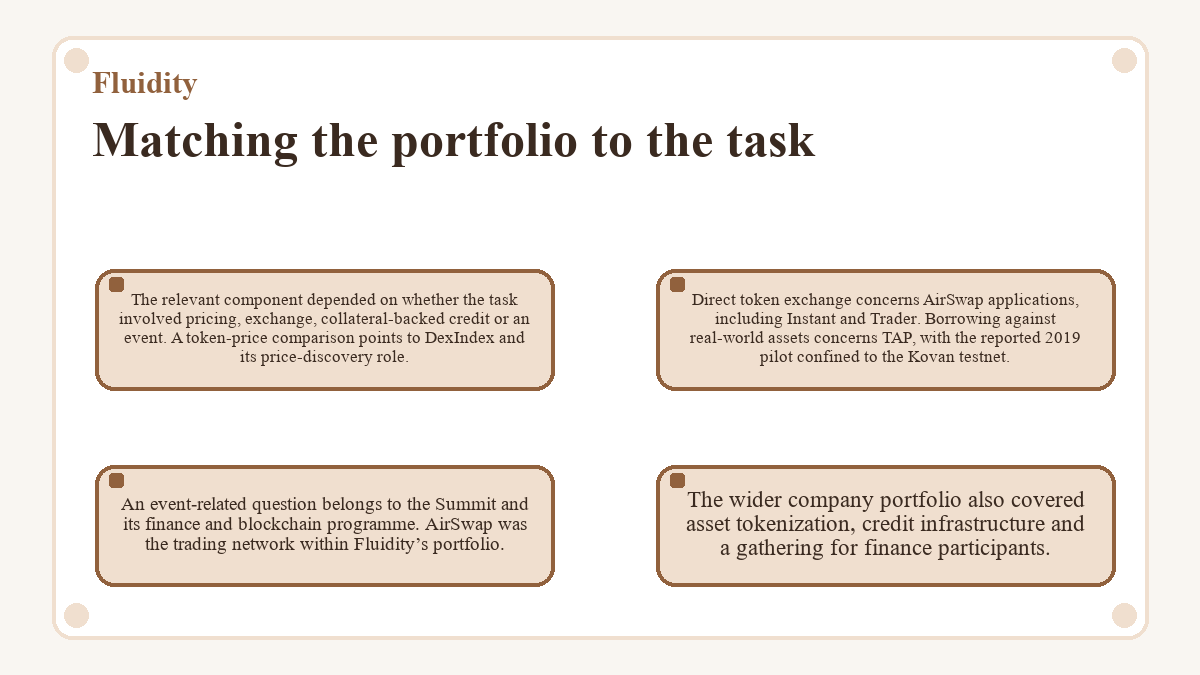
AirSwap was the trading network within Fluidity’s portfolio. The wider company portfolio also covered asset tokenization, credit infrastructure and a gathering for finance participants.
Key questions about Fluidity
How much did ConsenSys pay for Fluidity?
The financial terms were not disclosed in the May 22, 2020 acquisition announcement.
Who led Fluidity at the time of the acquisition?
Michael Oved was Fluidity’s CEO and co-founder when the acquisition was announced on May 22, 2020. The founders were to remain with the project as the team joined ConsenSys.
Which token did the AirSwap team launch?
The AirSwap team launched the AirSwap Token, identified by the ticker AST. The AirSwap Token Launch Report, published on October 14, 2017, announced completion of that distribution.
Could developers build their own applications on AirSwap?
Developers could build applications using AirSwap’s toolkit and API. The team’s December 19, 2018 annual review described community-built volume trackers, custom trading interfaces and desktop applications.
Did the acquisition announcement confirm new AirSwap token mechanics?
New token mechanics were a proposed area of work when the team joined ConsenSys in May 2020. The announcement did not specify a finished design or rollout date for those potential changes.
Was TAP intended to cover assets beyond U.S. Treasuries?
TAP’s July 2019 roadmap included mortgages, corporate bonds and equities as proposed extensions. Those plans covered a wider asset base than the U.S. Treasury collateral used in the reported Kovan pilot.
Could TAP be adapted to credit facilities other than MakerDAO?
The July 2019 TAP roadmap contemplated other decentralized credit facilities as well as MakerDAO. Broader deployment was a proposed extension of the model at that time, separate from the Kovan pilot that the team reported.
Updated on