 Fluidity
 tokenization and collateral for TAP’s testnet loan
Fluidity tokenization used the Tokenized Asset Portfolio (TAP) model to demonstrate decentralized borrowing against U.S. Treasury securities. The 2019 pilot borrowed Dai on the Kovan testnet. It showed collateral-backed credit in a test environment, while production collateral approval remained a separate step in the proposal.
In short: TAP’s 2019 Treasury-backed Dai loan demonstrated testnet borrowing on Kovan, with production collateral acceptance addressed separately in the proposal.
Token trading and collateral borrowing served different purposes
AirSwap supported exchanging Ethereum tokens, while TAP modeled credit against real-world collateral.
A token changing hands
Fluidity’s tokenized-securities work addressed assets that could trade through blockchain infrastructure, with AirSwap supplying peer-to-peer exchange. A trade changed which counterparty held the token. Its purpose was to exchange assets, whereas a TAP loan used represented assets to support a debt.
An asset supporting credit
TAP linked an underlying real-world asset to collateral that a decentralized credit facility could accept. In the pilot, U.S. Treasury securities provided the underlying backing and Dai was the borrowed asset.
AirSwap’s token launch concerned AST, a token with a different role from the Treasury collateral in TAP.
The Treasury-backed loan ran on the Kovan testnet
Fluidity’s July 25, 2019 TAP introduction reported a completed U.S. Treasury-backed Dai loan on the Kovan testnet. Kovan was an Ethereum testing environment, so the reported outcome concerned a demonstration there. That completed testnet loan and approval for production Treasury collateral were separate outcomes. The July 2019 introduction did not announce a public production lending offer.
Custody data and token controls connected the collateral
The pilot’s token design connected Treasury bill data with custody information and restricted issuance authority.
Asset identification and custody
The token contract included a Treasury bill identifier and custodian details. Position oracles used the custodian information to attest ownership.
Controlled issuance and transfers
The TAP sponsor controlled minting and burning. The model tied minting to Treasury purchases, while burning required sale and departure from custody. A whitelist restricted who could hold the token.
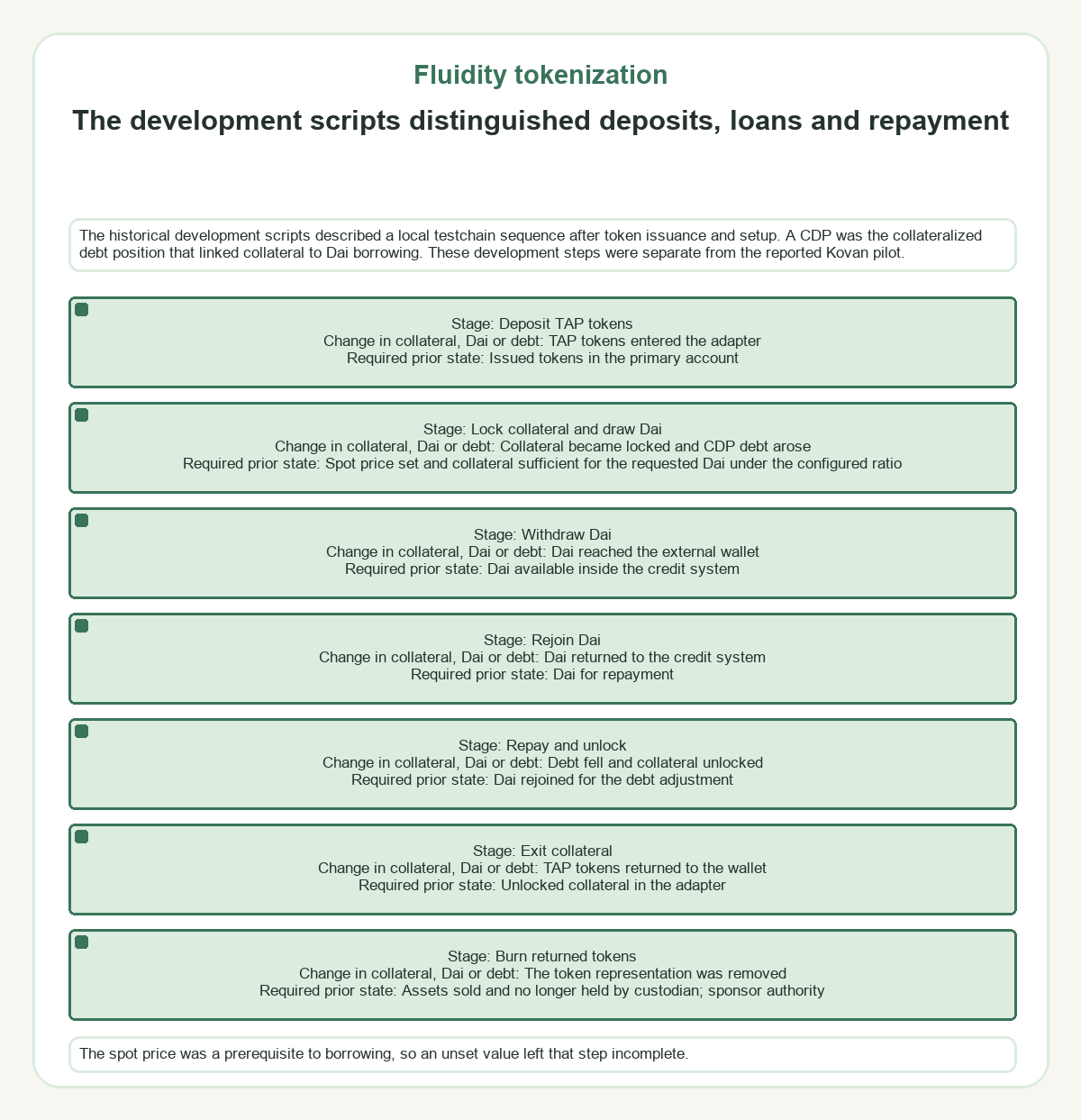
The development scripts distinguished deposits, loans and repayment
The historical development scripts described a local testchain sequence after token issuance and setup. A CDP was the collateralized debt position that linked collateral to Dai borrowing. These development steps were separate from the reported Kovan pilot.
| Stage | Change in collateral, Dai or debt | Required prior state |
|---|---|---|
| Deposit TAP tokens | TAP tokens entered the adapter | Issued tokens in the primary account |
| Lock collateral and draw Dai | Collateral became locked and CDP debt arose | Spot price set and collateral sufficient for the requested Dai under the configured ratio |
| Withdraw Dai | Dai reached the external wallet | Dai available inside the credit system |
| Rejoin Dai | Dai returned to the credit system | Dai for repayment |
| Repay and unlock | Debt fell and collateral unlocked | Dai rejoined for the debt adjustment |
| Exit collateral | TAP tokens returned to the wallet | Unlocked collateral in the adapter |
| Burn returned tokens | The token representation was removed | Assets sold and no longer held by custodian; sponsor authority |
The spot price was a prerequisite to borrowing, so an unset value left that step incomplete.
Collateral approval and asset expansion were separate transitions
In July 2019, Fluidity planned to petition MakerDAO to approve U.S. Treasuries after multi-collateral Dai launched. That request concerned the asset’s admission to the production credit system, beyond the completed testnet demonstration.
Multi-collateral Dai meant extending the credit system beyond Ether to other eligible collateral types.
Mortgages, corporate bonds and equities appeared among the planned extensions. These asset classes belonged to the proposed expansion, while U.S. Treasury securities supplied the underlying collateral in the reported pilot.
TAP’s model also contemplated other decentralized credit facilities. A different facility would bring its own collateral requirements, so a reusable representation alone would not establish eligibility for a loan there.
Borrowing terms determined the economic case
Fluidity expected introducing real-world collateral to improve credit terms and support Dai demand. That economic rationale depended on the loan terms offered by a credit facility.
The 2019 introduction published no universal TAP interest rate or standard loan duration. Borrowing cost, collateral valuation and repayment terms therefore had to come from the specific credit arrangement. Broad aims of flexible credit and yield enhancement did not amount to a numerical offer.
The 2020 acquisition changed the organizational setting
ConsenSys announced its acquisition of Fluidity’s team and technology on May 22, 2020. The plan included using Fluidity technology in Codefi, alongside continued AirSwap development. The acquisition announcement did not set new TAP collateral eligibility or borrowing terms.
A present borrowing decision turns on the actual credit facility, its accepted collateral and its applicable terms. The 2019 TAP demonstration provides a historical model for that assessment, without establishing a current enrollment offer.
What to know about Fluidity tokenization
Which token standard represented Treasury collateral in the TAP pilot?
The Treasuries pilot used an ERC-20 token to represent a Treasury bill. That token supplied the collateral representation for the multi-collateral Dai credit model.
Could a liquidation buyer receive TAP tokens without joining the whitelist?
The Treasuries pilot required token holders to be whitelisted, including recipients during a liquidation auction. Whitelist administrators could update that list.
Did TAP’s introduction include implementation code and legal documents?
The 2019 introduction identified published smart contracts, oracle scripts and draft legal documents. They addressed the technical implementation and the legal arrangements around real-world collateral. Draft legal documents described a proposed structure, without establishing final financing terms for every borrower.
How long did the Treasury-backed TAP pilot take?
The pilot’s elapsed duration was not specified in Fluidity’s July 25, 2019 announcement. The team reported completion on that date without giving a processing-time commitment for another loan.
Would AirSwap’s historical fee policy make a TAP loan free?
AirSwap’s historical no-trading-fee policy applied to token exchange and did not establish TAP’s borrowing costs. TAP involved debt secured by collateral, so its financial terms belonged to the credit arrangement.
Updated on